
Gernal
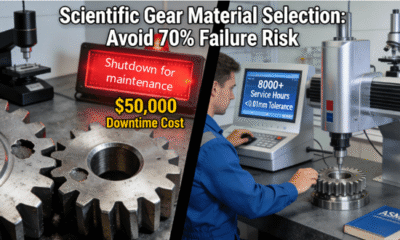
Avoiding Costly Mistakes: A Scientific Guide to Selecting the Best Material for Your Custom Gear Systems

Introduction
In the area of mechanical engineering, experts are generally confronted with the classic trade-off problem when designing custom gear systems: either selecting high-strength wear-resistant materials will result in extremely high costs and complicated machining processes, or selecting cost-effective materials may cause early failure under severe operating conditions, leading to substantial downtime and lost production. The problem essentially arises from conventional material selection procedures, which excessively rely on empirical equations and reference books, without conducting a comprehensive analysis of the actual operating conditions, such as impact loading, temperature, and lubrication conditions. This commonly causes either over-engineering or under-designing. Based on two decades of precision manufacturing expertise, this article introduces a scientific material selection procedure that systematically considers the interplay of operating conditions, material properties (such as fatigue strength and hardness), and cost-effectiveness.
With this guide, experts can make optimal decisions that simultaneously consider performance, lifetime, and costs. The subsequent sections will break down the entire procedure for scientific material selection.
How to Systematically Evaluate Operating Conditions to Determine Core Material Needs for Gears?
Accurate diagnosis of operating conditions is the first step towards scientific material selection. This ensures that the material is perfectly suited to the operating conditions of the gear, avoiding over-specification and under-specification.
1. Analyzing Key Operational Parameters
The first step in material selection is to identify and quantify various parameters, which include torque, speed, type of load (constant or impact), temperature, lubricating conditions, and corrosive conditions. For example, high-torque conditions require materials with high yield strength, whereas variable conditions require materials with high fatigue strength. The list of parameters is exhaustive and serves as the basis for all other decisions.
Linking Parameters to Material Property Requirements
As discussed, each of these parameters plays a vital role in the determination of the properties that the materials should exhibit. For example, high temperatures require materials with high thermal stability so that the materials do not soften. Additionally, low lubrication environments require materials with inherent lubricity or the ability to be made lubricant compatible. In other instances, exposure to corrosive substances requires materials with improved corrosion resistance.
Leveraging Authoritative Standards and References
One of the ways to make your content more credible is to provide citations from publications that are considered highly reliable sources. For example, the ASM Handbook is a great reference that provides detailed criteria of how different materials behave in various service environments. In the surface gear machining services material selection guide, the authors thoroughly examine the interplay of fatigue life, hardness, and microstructure. The readers can treat this piece of information as a clue for further investigation. Also, the engineer could consult other resources if he wants to delve into the study of extreme condition analysis.
What Are the Common Gear Materials and Their Performance in Typical Applications?
Simply put, there are no best materials in gear manufacture. In fact, the best material is the one whose properties are best suited for the particular application. This chapter will review the most popular materials for gears and compare their performance and most suitable applications.
Metallic Alloys: Strength and Durability
Alloy steels, for example, 4140 and 4340, are well-known for their high strength-to-weight ratios and good hardenability. These materials have been used for automotive transmission and machine component gears. Another example is case-hardening steels, like 20CrMnTi, which have a hard surface for wear resistance and a tough core for impact resistance.
Non-Metallic Options: Lightweight and Corrosion Resistance
Nylon and POM are engineering plastics that have various benefits, such as lightweight operation, noise reduction, and natural corrosion resistance. These materials are best suited for food processing equipment, domestic appliances, and applications where weight reduction is of utmost importance. On the other hand, bronze alloys are selected based on their wear resistance and compatibility with steel parts, commonly used in worm gears and bushes.
Making the Right Choice for Your Scenario
The choice of materials should be guided by the requirements of the application rather than by the relative ranking of materials only. In aerospace applications, where it is very important to save weight and to ensure reliability, high, strength steels or titanium alloys are used even though their price is higher. Whereas, for low, speed, non, critical applications, cast iron or plastics make good substitutes. By comparing the strength, hardness, cost, and machinability, one can limit the options.
How Do Heat Treatment and Surface Treatments Significantly Enhance Gear Performance and Lifespan?
Although the choice of the base material is a factor, one should also pay equal attention to the post, processing methods that significantly improve the performance and the durability of the gear parts.
l Core Enhancement Through Heat Treatment: Heat treatments such as carburizing, quenching and tempering, and induction hardening are the main methods that can be used to improve the properties of gear components. Carburizing, for instance, involves adding carbon to the surface of the gear component thereby greatly increasing its hardness and wear resistance, while the core still remains soft enough to absorb shocks and impacts. It is especially important that gear parts have both a hardened surface and a ductile core when they are subjected to repeated contact stress. Gear load capacity can be significantly increased if materials are properly heat treated to raise their fatigue strength as evidenced by the ISO 6336 standard which associates the quality of heat treatment to gear load capacity.
l Surface Engineering for Superior Performance: Surface engineering comprises nitriding and Diamond, Like Carbon (DLC) coating which impart an extra layer of defense. Nitriding produces a hard and corrosion, resistant surface layer with minimum distortion which is ideal for making gears with very precise dimensions that require tight tolerances. A DLC layer is also a very good option for reducing friction and wear, especially under conditions of poor lubrication. Both of these processes are widely utilized in the automotive and aerospace sectors in order to achieve performance standards that are better than ever.
l Ensuring Consistency Through Quality Controls: In demanding industries, following quality management systems such as ISO 9001 and IATF 16949 very closely can allow heat treatment processes to become not only precisely controlled but also consistent. This is very important both for attaining the global standards and for delivering the performance that is replicable. Enterprises conforming to these standards have developed strong mechanisms that eliminate the risk of inconsistencies which might lead to premature breakdowns.
How to Conduct a Cost-Benefit Analysis Without Compromising Gear Quality?
A wise material selection approach is to look beyond the initial cost of the material to the overall cost of ownership, which includes the complexity of machining, cost of heat treatment, expected life, and any possible maintenance costs.
1. Calculating Total Cost of Ownership
TCO (Total Cost of Ownership) analysis considers various costs associated with the material over and above the material price. For instance, while steel is cheaper than other alloys, frequently replacing steel gears will cost more in the long run compared to using a costly higher, grade alloy that will last longer.
2. Value Engineering for Optimum Design
Value engineering is an approach that seeks to eliminate performance waste that is unnecessary. It is an approach that seeks to match the material perfectly with the application. For example, in the case of gears that are subjected to moderate loads, an ultra-high-strength alloy is overkill. It is better to use an alloy that is mid-grade and apply value engineering to the design to make sure that it is reliable.
3. Case Example: Long-Term Savings Analysis
Just consider a scenario where the carbon steel gear is initially more cost, effective but it only lasts 5, 000 hours thus necessitating replacements quite frequently. Whereas, an alloy steel gear, if subjected to the right heat, treatment, can easily give you a service of 15, 000 hours with hardly any maintenance required. Even if the alloy steel gear is pricier, it still ends up having a lower TCO due to the fact that the savings from fewer replacements and downtime more than make up for the higher initial cost.
Can Real-World Case Studies Demonstrate the Value of Scientific Material Selection?
Real-world case studies demonstrate the effectiveness of a scientific material selection approach in achieving success in the real world by applying theoretical concepts in a practical manner.
1. Case Background: Addressing Premature Failure
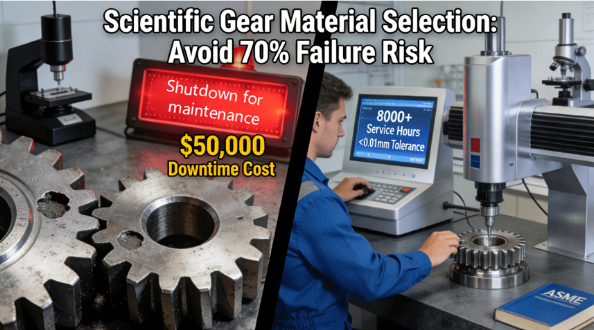
One of the leading manufacturers of construction equipment faced a continuous pitting problem on the gears made from 20CrMnTi material, with the gears lasting no more than 3000 hours.
2. Scientific Solution Implementation
The fail analysis and condition mapping indicated that the remedy was changing the material to 18CrNiMo7, 6 carburizing steel and modifying the heat treatment processes. The newly chosen material possesses both good core toughness and surface hardness, which enables it to withstand the most severe impacts. Along with the optimized process, implementation of tighter in, process controls to guarantee the product consistency was done.
3. Measurable Outcomes and Benefits
The results showed that the gear life was increased to above 8,000 hours, with a 70% decrease in failure rates. This change not only reduced maintenance costs but also improved machine reliability, proving the value of data-driven decisions.
H2: What Are the Step-by-Step Actions to Implement the Scientific Material Selection Framework?
Applying the approach requires the execution of a systematic, five, step action plan that essentially transforms analysis into action thus, the project risks are lowered to a minimum.

- Define Requirement Specifications: Start by making a detailed list of requirements that covers all load, environmental, and life parameters. This requirements list is basically a checklist that guarantees no requirements are overlooked.
- Shortlist Candidate Materials: From the requirements, select 2-3 candidate materials that satisfy the key requirements. Data sheets and comparative charts are available that compare the performance of different materials with respect to one another, especially with regards to strength, hardness, and cost.
- Evaluate Manufacturing Feasibility: Then, the machinability and heat treatment necessities of the materials are checked.Manufacturing process evaluation is very important and includes the assessment of time, tool wear, and availability of equipment that can perform the process. One great thing is to get in touch with manufacturing specialists that can give an enlightening opinion about the possible problems that may be encountered during the process.
- Simulate Cost-Benefit Scenarios: Here, the TCO of all the materials will be simulated, considering their initial costs, processing costs, and lifespan. This will also enable the use of simulation techniques, which will aid in the visualization of the final outcome, thus creating a balanced approach for decision-making.
- Prototype and Validate: Finally, prototypes will be created for validation testing under accelerated conditions. Validation testing will verify the predictions made, and the process will be fine-tuned before proceeding into full-scale production. This process is of utmost importance for applications of high consequence.
Conclusion
Thus, the selection of the best possible material for use in custom gear machining services is a complex process. However, if the working conditions are assessed and the interaction of materials with the process is well understood, along with a detailed cost-benefit analysis, the performance-cost dilemma of materials can be overcome. This scientific approach will enable the creation of an optimized design, which will result in a product with performance, longevity, and cost-effectiveness.
FAQs
Q1: Is there professional advice on choosing materials for low, volume production runs?
A: Definitely, various well, known manufacturers provide engineering support for material selection, and a low, volume production run strategy will be considered in the choice of standard materials that are easily available to reduce cost and lead time, and through the supplier collaboration, the use of special heat treatments to attain the desired properties can also be considered.
Q2: How do we evaluate the feasibility of changing the material if we are not satisfied with the performance of our current gear material?
A: Initially, a failure analysis of the existing gears must be conducted, followed by defining new performance criteria. Afterward, the materials should be tested against the new criteria, and the assistance of the manufacturer can be sought for failure analysis and modeling.
Q3: What is the future outlook for new materials (such as composites) in gear applications, and how do they compare to traditional metals?
A: There are a couple of benefits from new materials such as composites, for example, they are lightweight and corrosion resistant in certain applications, but their load carrying capability and cost effectiveness are still significantly lower when compared with traditional metals. Generally, metallic alloys continue to be the predominant materials for heavy industrial applications, while new materials are utilized for niche markets only.
Q4: Apart from the basic material, what else is essential for the final life of a gear in service?
A: Besides the main material, there are a number of factors which are essential such as the absolute accuracy of the gear tooth profile, the exquisite manufacturing process, the uniformity of the heat treatment, the effectiveness of the lubrication system, and the correctness of installation alignment. Even the best material is powerless against design defects, inferior manufacturing, or unsuitable operating conditions.
Q5: How reliable are predictions of gear life using material information and simulation models?
A: Using current simulation models with precise load information and accurate material properties, predictions of gear life are quite reliable for comparison purposes and for detecting early signs of weakness. Nevertheless, prototype testing in real-life conditions is still the best method for final validation in high-stakes applications.
Author Bio
The author is a precision manufacturing specialist at LS Manufacturing. The company supports engineers and researchers in solving complex part challenges in the aerospace, medical, and automotive industries. The team maintains the highest quality standards through advanced technologies by combining their skills with the certifications IATF 16949 and AS9100D. For additional information, you may get in touch with them and avail yourself of a free, no, obligation project review and DFM analysis. Switch your idea into a cost, effective product.

Family support plays a powerful role in helping individuals move through challenging periods. When someone is struggling, the people closest to them often feel the impact as well. Emotions can become heightened, communication may break down, and uncertainty can make it difficult to know how to help in a constructive way.
With the right approach, family support can become a steady foundation for meaningful and lasting change. By focusing on understanding, communication, and consistency, families can create an environment that encourages progress rather than pressure.
Understanding the Role of Family in Personal Change
Every individual’s situation is influenced by personal experiences, emotional wellbeing, and daily responsibilities. At the same time, family dynamics can shape how challenges develop and how they are addressed.
In many situations, addiction family support becomes an important part of the recovery process when individuals and families recognize that guidance is needed beyond informal conversations. Learning how to provide support in a balanced and informed way helps reduce conflict and improve overall stability.
Building Healthy Communication Patterns
Communication is often one of the first areas affected during difficult times. Misunderstandings, emotional reactions, and frustration can create distance between family members.
Effective family support focuses on building clear and respectful communication. This includes listening without judgment, expressing concerns calmly, and creating space for open dialogue. Over time, these changes can strengthen relationships and support more positive outcomes.
Creating a Supportive and Stable Environment
A stable environment can make a meaningful difference in encouraging change. Consistency, clear expectations, and mutual respect all contribute to a sense of security.
When families work together to establish healthy routines and boundaries, individuals are more likely to feel supported rather than pressured. This type of environment allows progress to develop naturally and at a sustainable pace.
Addressing Underlying Challenges
Many challenges are connected to deeper emotional or behavioural patterns. Stress, anxiety, and past experiences can all influence how individuals cope and respond to situations.
In some cases, cannabis addiction support becomes part of the broader conversation when individuals and families recognize the need to address specific patterns that are affecting wellbeing. Understanding these underlying factors helps create a more effective and supportive approach.
Supporting Emotional Wellbeing for Everyone
Difficult situations affect both individuals and their families. Feelings of stress, frustration, and uncertainty are common on all sides.
Family support should also include attention to emotional wellbeing for everyone involved. Learning how to manage stress, maintain balance, and recognize personal limits helps families remain supportive without becoming overwhelmed.
Encouraging Consistency and Patience
Meaningful change takes time. Progress is rarely immediate, and setbacks can be part of the process.
Family support encourages consistency by reinforcing positive habits and maintaining a steady presence. Patience and understanding help individuals feel supported as they continue working toward their goals.
Adapting Support Over Time
Situations change, and support needs to evolve alongside them. What feels helpful at one stage may need to be adjusted as progress is made or new challenges arise.
Being flexible allows families to continue providing support that reflects current needs. This adaptability helps maintain progress and encourages long-term stability.
Building a Positive Path Forward
Family support can be a powerful force for meaningful change when it is grounded in understanding, communication, and consistency. By creating a supportive environment and adapting to changing needs, families can help individuals move forward with greater confidence.
Over time, this approach builds stronger relationships, improves emotional wellbeing, and creates a more stable foundation for lasting progress.

In today’s world of marketing, one of the most significant shifts has been the rise of User-Generated Content (UGC). While traditional advertising methods still hold their ground, UGC has emerged as an invaluable tool for brands looking to connect with consumers on a personal level. Especially in influencer marketing, UGC plays a crucial role in humanizing brands and building authentic relationships with target audiences.
This article explores the importance of UGC video creators in influencer marketing, how they can help brands gain trust, and how businesses can harness this power to boost their marketing efforts.
Understanding User-Generated Content (UGC) and Its Role in Video Marketing
User-Generated Content (UGC) refers to any type of content, including videos, images, reviews, or testimonials, created by consumers or users rather than the brand itself. UGC videos, in particular, are a powerful form of content where consumers share their real-life experiences with a product or service. These videos offer an authentic, unpolished portrayal of how a product is used, which can resonate strongly with audiences, especially those who value transparency and relatability.
In marketing, UGC plays a critical role in building trust and fostering a sense of community. Unlike traditional advertisements, which are often scripted and polished, UGC feels more raw and genuine, giving it an edge in influencing consumer perceptions. As consumers create content about a brand, they not only promote the product but also become an integral part of the brand’s narrative. This personal connection enhances the brand’s credibility and encourages greater consumer engagement, making UGC a key tool in modern video marketing and often driving viral content.
How Can Brands Leverage UGC Video Creators?
Leveraging UGC in video marketing is a great way to harness the power of user-created content while maintaining control over the overall brand narrative. Brands can utilize UGC videos to showcase products in action, highlight customer testimonials, and create relatable ads that resonate with their target market.
Here’s how brands can work with UGC video creators:
1. Incorporating UGC in Ads
Many brands now feature UGC in their advertisements, showing real customers interacting with their products. This can include testimonial videos, unboxing videos, product demos, or skits that showcase the product’s functionality in a relatable way.
By featuring authentic UGC in their ads, brands can create more engaging and relatable content that feels genuine to viewers. One such way to create these UGC ads is by using tools like invideo’s ugc ad feature, where brands can generate ready-to-use AI-powered UGC videos that feature real or virtual actors. These videos can be crafted quickly and easily, showcasing testimonials or product demos in a style that feels real and natural.
2. Partnering with Influencers to Create UGC
Brands can collaborate with influencers to create UGC in the form of videos. Influencers can record their experiences with the product and share them on their social media channels. This content can then be repurposed for the brand’s marketing efforts. Collaborating with influencers ensures that the UGC is shared with a wider audience, driving traffic to the brand and increasing its visibility.
3. Encouraging Customers to Create UGC
Brands can motivate their customers to create UGC by hosting contests or offering incentives for sharing videos of themselves using the product. User-created videos can then be shared across the brand’s social channels or featured in ads. This not only creates social proof but also strengthens the connection between the brand and its audience.
4. Repurposing Existing UGC
Once brands receive user-generated videos, they can repurpose them into a variety of formats. This could include turning longer testimonial videos into shorter clips for social media, integrating UGC into email campaigns, or incorporating it into video ads for TV or YouTube. By using UGC in various formats, brands can extend the life of the content, reach a broader audience, and improve their overall marketing ROI.
How Can UGC Videos Enhance Influencer Marketing?
Influencer marketing is a crucial component of modern digital strategies, and when combined with UGC videos, it can produce incredible results. Influencers, who are trusted by their followers, can create impactful video content that promotes products in an organic and relatable manner. Here’s how UGC video creators are enhancing influencer marketing efforts:
1. Amplifying Brand Authenticity
Influencers have built relationships with their audience based on trust and transparency. When they share their experiences with a product through UGC videos, it adds credibility to the brand message. This organic form of advertising is much more likely to resonate with the audience, as it feels like a recommendation from a trusted friend rather than a brand pushing a product.
2. Creating More Engaging Content
Content that features people using products is often more engaging than traditional advertisements. UGC videos help brands create compelling content that tells a story, making it more likely that viewers will pay attention, engage, and share the content. These videos feel more personal and have a higher chance of being shared across social platforms, which increases visibility. Using tools like a video maker app can help turn these organic UGC moments into high-quality, shareable content that resonates with audiences.
3. Boosting Social Proof
UGC videos serve as powerful social proof. When a product is seen being used and endorsed by a variety of people, it builds confidence among potential buyers. Consumers are more likely to trust the experiences of their peers rather than the marketing efforts of a brand. UGC videos provide tangible evidence of a product’s benefits and effectiveness.
How Do UGC Video Creators Add Value to Your Brand?
UGC video creators whether they are influencers or everyday consumers bring several key benefits to a brand’s marketing strategy.
- Cost-Effective Marketing:
Traditional video production can be expensive, especially when high-end equipment, talent, and time are involved. However, UGC provides an affordable alternative. Brands can leverage the videos that their customers already create, saving costs while still showcasing their products in an authentic way. - Increase Conversion Rates:
UGC has been shown to increase conversion rates. When customers see others using and enjoying a product, they are more likely to make a purchase. UGC videos humanize the brand, making it more approachable and trustworthy in the eyes of potential buyers. - Improves Brand Awareness:
When influencers or customers post videos about your brand, they increase its visibility. Every time someone shares a UGC video, it introduces the brand to new audiences, ultimately helping to grow brand awareness. Additionally, when these videos are shared across social media, they provide organic, word-of-mouth marketing that carries a lot of weight. - Encourages Creativity and Community Engagement:
UGC videos often encourage creativity and foster a sense of community among users. When consumers create content, they feel like they are part of something bigger, which leads to deeper brand loyalty and more frequent interaction with the brand. This sense of involvement can help brands create lasting relationships with their audience.
Conclusion
The role of user-generated content (UGC) video creators in influencer marketing is important. Brands want to connect with their customers in real ways, and UGC provides an effective solution. By using UGC videos, brands can build trust, boost engagement, and create social proof that speaks to their audience.
As people continue to seek authentic content, more businesses will see the benefits of UGC and influencer marketing. By working with influencers, encouraging customers to create content, and using AI tools, businesses can enhance their marketing efforts and stand out online. Harness the power of UGC video creators to improve your influencer marketing strategy and watch your brand grow in an authentic and engaging way.
Gernal
How Online CNC Turning Services Achieve 30% Cost Savings Without Compromising Speed or Quality
Introduction
In today’s competitive market, product development teams and procurement engineers face a common problem: pay a high premium to achieve rapid delivery or wait long production cycles to save costs. Communication challenges and unclear quoting mechanisms in traditional manufacturing processes only make project timelines and budget risks more complicated. The underlying reason for this problem, however, is that traditional supply chains are inherently inefficient and lack transparency. Each step of the process, from initial inquiry to production, creates a possible delay and uncertainty, making it very difficult to plan a project.
This article will explore the concept of professional online CNC Machining Services, including how it helps to achieve acceleration and cost reduction in manufacturing while maintaining precision quality. So, what’s the magic behind online CNC turning services? The answer to that question can be broken down into five important areas.
How to choose a reliable online CNC turning service to ensure part quality?
Selecting a partner for CNC turning services requires a careful evaluation of several core competencies to guarantee the quality of the final components.
Technical and Equipment Capabilities
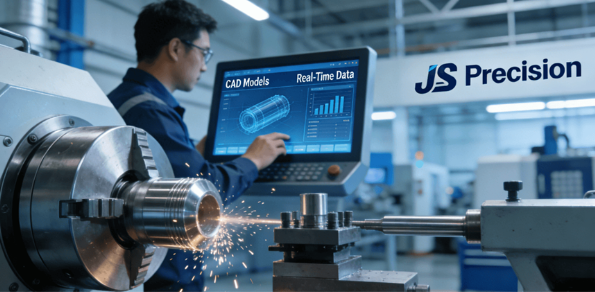
The starting point of quality is advanced technology. A quality service provider is one that has the latest technology, such as multi-axis turning centers, which help in the manufacture of complex shapes with precision. Another important factor is the expertise of the technical staff who are capable of programming the process in order to handle different types of materials.
Systematic Quality Assurance
Quality is not something that occurs by chance. Reliable service providers are typically ones that have quality certification, which is a measure of their professionalism and a guarantee of a system that is capable of producing quality products such as CNC Precision Turning
l General Quality Management
ISO 9001 certifications show that there is a standard quality management system in place for all processes, including design, production, and service.
l Industry-Specific Certifications
In high-quality industries like the automotive industry, which requires reliability, traceability, and safety, industry-specific certifications like IATF 16949 or AS9100D show that the quality management system is up to high standards.
Digital Transparency and Value Assessment
Professional online manufacturing platforms use instant quoting systems to create transparency about price and manufacturability analysis, which is usually lacking in traditional methods. One common mistake to avoid is choosing the manufacturing partner solely on the basis of price. The cost associated with compromised quality, lack of technical support, and an unreliable supply chain is usually much higher in the long term compared to the cost savings. A comprehensive platform like the CNC turning services offered by JS Precision is an example of an integrated approach to manufacturing.
Where are the key quality control points for precision turned components?
The manufacture of precision turned components of high standard is a process where quality control plays a pivotal role at various steps. The basic parameters of the process, such as cutting speed, feed rate, and tool material, have a direct effect on the surface finish, accuracy, and geometric tolerance of CNC Precision Turning Parts. A slight deviation in these parameters can cause problems such as chatter marks, burrs, or dimensional errors.
The problem is more acute in the precision turning of steel components. Various types of steel (free-cutting steel, alloy steel, and stainless steel) require different tool materials, cooling systems, and cutting parameters based on differences in hardness, thermal conductivity, and work hardening properties. For example, turning stainless steel requires efficient heat removal to avoid deformation of the material and prolong tool life.
Precision inspection is the quality watchdog. Sophisticated inspection tools such as Coordinate Measuring Machines (CMMs) and optical comparators are necessary for inspecting components against CAD designs to check micron-level accuracy. Data-driven inspection, along with Statistical Process Control (SPC) techniques recommended by recognized institutions such as the Society of Manufacturing Engineers (SME), plays a vital role in maintaining consistency in batch production.
How does the CNC turning process adapt to the entire workflow from prototyping to mass production?
The CNC turning process is exceptionally well-suited to the entire product lifecycle, from concept to market, owing to its flexibility and consistency.
From Digital Design to Physical Prototype and Beyond
A basic CNC turning process begins with a CAD file, which is converted to machine instructions with the help of CAM software. This digital nature makes it an ideal tool for the iterative philosophy that any Rapid Prototyping Guide advocates, allowing designers to create physical prototypes in mere days. The process continues to a detailed engineering phase where professional teams analyze and optimize it further.
l Design for Manufacturability (DFM) Analysis
In this phase, professional engineering teams undertake Design for Manufacturability (DFM) analysis, offering suggestions to further improve the product’s strength, simplify it, or even make it less expensive. For instance, even a small change to a design for CNC Precision Turning Parts could result in considerable time savings or even eliminate the need to create special tools.
Access to Technical Expertise and Case Studies
Readers can explore specific technical details and real-world machining cases by reviewing this resource on CNC Precision Turning Parts, which provides deep insights into the application of these principles.
Seamless Scaling for Volume Production
After the prototype has been validated, the benefits of custom CNC turning services will become even more clear. With validated programs, optimized fixtures, and optimized processes, suppliers can scale production from a prototype to hundreds or thousands of units. This seamless scaling ensures quality throughout the life cycle of the product without having to go through the qualification process again with a new supplier.
How does the online on-demand production model reduce costs and increase efficiency for enterprises?
The on-demand part production model, enabled by advanced online manufacturing solutions, fundamentally reshapes corporate supply chains and cost structures. Primarily, it drastically reduces inventory carrying costs and capital investment risks. Companies no longer need to stockpile parts for forecasted demand, converting “inventory” into “in-transit goods” and freeing up significant cash flow.
Secondly, online manufacturing platforms streamline the traditionally lengthy and inefficient multi-step process (finding suppliers, requesting quotes, technical communication, order tracking) into a few simple steps for the user. Uploading drawings, receiving instant quotes, placing orders online, and tracking production progress—this digital workflow drastically reduces communication costs and human error, allowing procurement staff to focus on more strategic tasks.
According to reports from industry associations like the European Committee for the Co-operation of the Machine Tool Industries (CECIMO) on digital trends, this integrated and transparent supply chain is the future of manufacturing. A typical case study might show how a company consolidated its R&D department’s scattered part requests through an online platform. By leveraging the platform’s process optimization algorithms and bulk purchasing power, the company achieved an overall procurement cost reduction of approximately 30% while maintaining quality, and simultaneously reduced the average lead time by 40%, truly achieving the dual goal of cost reduction and efficiency improvement.
What solutions does multi-axis CNC turning technology offer for complex parts?
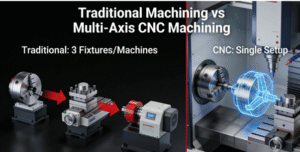
For complex geometries, conventional turning methods are not sufficient, and multi-axis CNC turning technology offers a revolutionary solution. Machines equipped with five-axis simultaneous movement capability enable turning, milling, drilling, and tapping operations in a single setup.
This complete-in-one-setup approach is a decisive advantage for machining complex precision turned components such as eccentric shafts or parts with complex contours. It not only eliminates the datum errors associated with multiple setups, ensuring extremely high geometric tolerances (like concentricity and perpendicularity), but also enables the production of single, integrated complex parts that would previously require multiple assemblies, thereby enhancing overall product strength and reliability.
Consequently, multi-axis technology significantly expands the capabilities of CNC Machining Services. It highly integrates what was once a lengthy, discrete CNC turning process, simplifying the workflow, shortening the total production cycle, and markedly reducing the cost and quality risks associated with process changeovers. It is a core technology in high-end precision manufacturing.
Conclusion
In a nutshell, it can be said that through the selection of online manufacturing services that possess superior technical capabilities and quality systems, it is possible to achieve full optimization in terms of speed, cost, and quality in the manufacturing of precision parts. By utilizing efficient digital platforms and superior CNC turning technology, it is definitely possible to achieve this goal. This not only helps to address current market challenges but is a significant step towards future intelligent manufacturing.
If you are looking to achieve a faster, more cost-effective, and efficient solution to your precision turned part needs for a critical project, it is highly advisable to upload your part drawings to a reputable online platform today and obtain an instant quote and manufacturability analysis to get started with optimizing your supply chain.
Author Biography
The article is penned by a precision manufacturing expert with more than 15 years of experience and is focused on sharing the latest in precision manufacturing technology and supply chain management expertise. His expertise has helped several of the world’s leading industrial technology companies. The information provided in this article is backed by the technical expertise of a precision manufacturing service provider.
FAQ Section
What is the general lead time for online CNC turning services?
A1: Generally speaking, the lead time will vary depending on the complexity of the part and the quantity of the parts to be produced. For moderately complex parts in standard materials, professional online CNC turning service providers can normally provide prototypes within a 3-7 day time frame and production within a 10-15 day time frame.
How is the dimensional accuracy of the turned parts, ordered online, ensured?
A2: Professional online CNC turning service providers will normally provide detailed quality inspection reports, often via Coordinate Measuring Machines (CMMs). It is important that the accuracy of the parts be specified in the online inquiry and that the inspection capabilities of the supplier match the specified tolerance ranges.
Do online platforms support CNC turning of various special materials?
A3: Yes, there are dozens of metal and engineering plastic materials available on the online platforms, ranging from stainless steel, aluminum, to PEEK, titanium, etc. The online platforms’ material libraries will normally provide information on the properties and application scenarios of the various materials for the user to select from.
How are situations usually dealt with if the received parts do not live up to expectations?
A4: Formal service providers have proper procedures for resolving quality disputes. As soon as a non-conformity is identified, communication with supporting inspection data should be started right away. Suppliers with certifications such as AS9100D usually have proper corrective and preventive action procedures to safeguard the rights of clients.
Is this model appropriate for low-volume, high-mix R&D requirements?
A5: It is very appropriate. One of the major benefits of the online on-demand production model is its flexibility in dealing with low-volume, high-variety production. It substantially lowers the startup cost per part, making it very appropriate for the R&D stage.


How Family Support Encourages Meaningful Change
Family support plays a powerful role in helping individuals move through challenging periods. When someone is struggling, the people closest...


Why Mirror Lights and Pendant Fixtures Are a Must for Modern Homes
Lighting is no longer just about visibility—it’s a key part of interior design. Modern homes rely on a combination of...


The Power of UGC Video Creators in Influencer Marketing
In today’s world of marketing, one of the most significant shifts has been the rise of User-Generated Content (UGC). While...

How Online CNC Turning Services Achieve 30% Cost Savings Without Compromising Speed or Quality
Introduction In today’s competitive market, product development teams and procurement engineers face a common problem: pay a high premium to...

Avoiding Costly Mistakes: A Scientific Guide to Selecting the Best Material for Your Custom Gear Systems
Introduction In the area of mechanical engineering, experts are generally confronted with the classic trade-off problem when designing custom gear...


Labarty: Hidden Gems and Off-the-Beaten-Path Spots
Nestled away from the bustling tourist trails, Labarty is a treasure waiting to be uncovered. This charming destination boasts stunning...


How Much Is Cost Segregation Study? A Practical Pricing Guide for Real Estate Owners
If you own income-producing real estate, you’ve probably heard that a cost segregation study can accelerate depreciation and unlock meaningful...


How Custom Development Enables Scalable Digital Transformation
Digital transformation is no longer a short-term initiative. It is an ongoing process that needs systems capable of growing alongside...


How Long Does It Take to Be a Surgical Tech
If you’re asking how long it takes to be a surgical tech, you’re likely trying to plan your next move...

The Comprehensive Guide to Forklift Rentals: Enhancing Efficiency, Safety, and Flexibility in Industrial and Warehouse Operations
In modern industrial, warehouse, and construction operations, the ability to move, lift, and transport heavy materials efficiently is essential for...
-

 Guide9 months ago
Delta Flight DL275 Diverted to LAX – What Happened?
-

 Technology7 months ago
The Importance of User Feedback Loops in AI Slide Builders
-

 How to9 months ago
How to Get My Instagram Password on Android
-

 Social Media9 months ago
Go Viral Overnight: Proven Instagram Power Moves to Beat the Algorithm
-

 Social Media9 months ago
Going Viral in the Digital Age: Meaning, Importance, and Practical Tips
-

 Social Media9 months ago
7 Powerful Tips to Reach More People on Facebook (Without Spending a Fortune)
-

 How to9 months ago
How to Turn Instagram Followers into Real Customers
-
Viral Tips2 years ago
Make Money Online from Home 2024